
Signal Correlation
Contents
Signal Correlation#
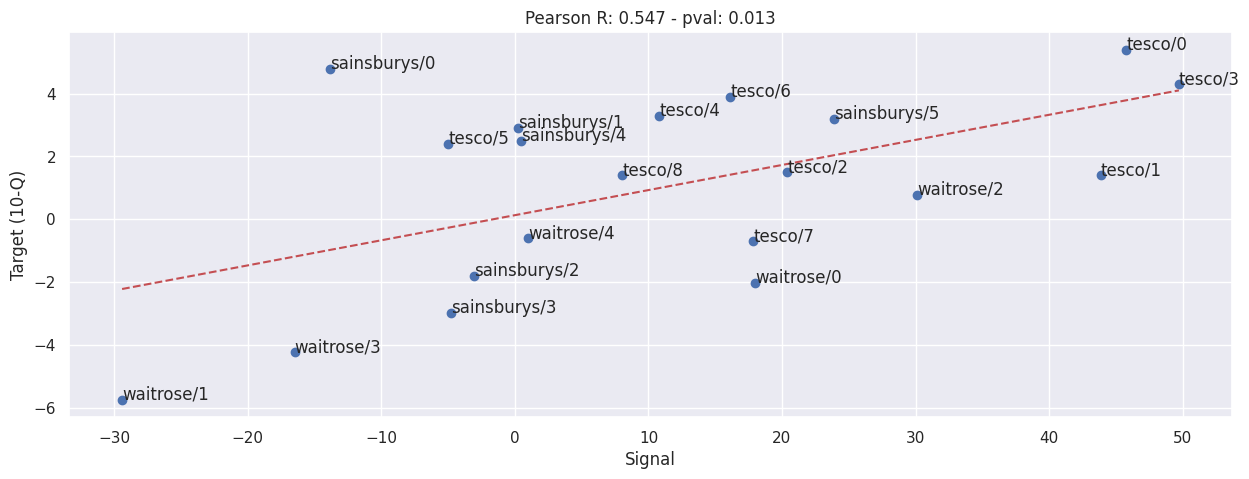
In this section we will examine our signal and see if it correlates to some other observed real world measures that one would normally be interested in knowing.
For the purposes of this study we shall be using in stores sales, these should be reported by trading statements of public traded companies (10-Q/10-K in the US, we will just call trading statements and 10-Q interchangeably for simplicity).
Let’s just assume there is a linear relationship from visit duration per capita to store sales for simplicity.
And to further keep things simple, we will just be summing our signals up per reporting period and comparing them by a percentage change basis (more on why we used this in [Faw15], specifically the dealing with trend section), without accounting for inflation or anything else.
Note
We will opt to use large supermarket store sales if they are reported.
Example: Sainsbury’s report large supermarket sales and convenience stores separately.
Note
If the brand’s channel of sales are not broken down in trading statemnts, we will not be including said brand in this study.
# Configuration and import
import pandas as pd
import matplotlib.pyplot as plt
import seaborn as sns
from IPython.display import display

sns.set_style("darkgrid")
sns.set(rc={"figure.figsize": (15, 5)})

# Dataframe display util
def display_shrinked_dataframe(df_big):
    display(
        pd.concat(
            [df_big.select_dtypes(include="datetime").astype(str), df_big.select_dtypes(exclude="datetime")],
            axis=1,
        ).style.set_table_attributes('style="font-size: 8px"')
    )
# Read genereated signals
df = pd.concat(
    [
        pd.read_parquet("./data/output/asda.parquet"),
        pd.read_parquet("./data/output/sainsburys.parquet"),
        pd.read_parquet("./data/output/waitrose.parquet"),
        pd.read_parquet("./data/output/tesco.parquet"),
        pd.read_parquet("./data/output/morrison.parquet"),
    ],
    axis=1,
)
TARGETS = {}
SIGNALS = {}
# A small helper in evaluating correlation between two series
import scipy
import matplotlib.pyplot as plt
from sklearn.linear_model import LinearRegression
import numpy as np


def evaluate(signals, targets):
    signal_series = pd.Series(signals)
    target_series = pd.Series(targets)
    fig, ax = plt.subplots(1, 1, figsize=(15, 5))
    pearsonr, pval = scipy.stats.pearsonr(signal_series, target_series)

    ax.scatter(signal_series, target_series)
    ax.set_title(f"Pearson R: {round(pearsonr, 3)} - pval: {round(pval, 3)}")

    # LR to illustrate correlation, not used as prediction.
    linear_regression = LinearRegression()
    df_signal = pd.DataFrame({"signal": signal_series})
    linear_regression.fit(df_signal, target_series)
    xs = np.linspace(signal_series.min(), signal_series.max(), 10)
    ax.plot(xs, linear_regression.predict(pd.DataFrame({"signal": xs})), "r--")

    # Add some annotation
    for text, coor in (pd.concat([signal_series.rename("x"), target_series.rename("y")], axis=1)).iterrows():
        ax.annotate(text, (coor["x"], coor["y"]))

    plt.xlabel("Signal")
    plt.ylabel("Target (10-Q)")
# A small helper to extract signal sum to 10q dataframe
def extract_siganl_sum(df_10q, brand):
    for modifier in ['base', 'comp']:
        for ind, row in df_10q.iterrows():
            normalised_traffic = df[brand]
            normalised_traffic_filtered = normalised_traffic[
                (normalised_traffic.index >= row[f"{modifier}_start_date"])
                & (normalised_traffic.index <= row[f"{modifier}_end_date"])
            ]

            # Sanity check we actually have output for all dates in question.
            signal_len = len(normalised_traffic_filtered.index)
            target_len = (row[f"{modifier}_end_date"] - row[f"{modifier}_start_date"]).days + 1

            if abs(signal_len - target_len) > 0:
                raise RuntimeError()

            df_10q.loc[ind, f"{modifier}_summed_visit_duration_per_capita"] = normalised_traffic_filtered.sum()
# A small helper to read 10q dataframe and create the start dates in 10-Q dataframe
def read_10q(path):
    df_10q = pd.read_csv(path, parse_dates=["comp_end_date", "base_end_date"])

    if "comp_weeks" in df_10q.columns:
        print('creating start dates from weeks')
        df_10q["comp_start_date"] = df_10q["comp_end_date"] - pd.Timedelta("7 days") * df_10q["comp_weeks"]
        df_10q["base_start_date"] = df_10q["base_end_date"] - pd.Timedelta("7 days") * df_10q["base_weeks"]
    if "comp_months" in df_10q.columns:
        print('creating start dates from calendar months')
        with warnings.catch_warnings():
            df_10q["comp_start_date"] = df_10q["comp_end_date"] - df_10q['comp_months'].apply(pd.offsets.MonthBegin)
            df_10q["base_start_date"] = df_10q["base_end_date"] - df_10q['base_months'].apply(pd.offsets.MonthBegin)
    if "comp_modifier" in df_10q.columns:
        print("modifing net sales values by modifier")
        df_10q["comp_net_sales"] = df_10q["comp_net_sales"] * df_10q["comp_modifier"]
        df_10q["base_net_sales"] = df_10q["base_net_sales"] * df_10q["base_modifier"]
    if "comp_subtraction" in df_10q.columns:
        print("sutracting net sales values by indicated amount")
        df_10q["comp_net_sales"] = df_10q["comp_net_sales"] - df_10q["comp_subtraction"]
        df_10q["base_net_sales"] = df_10q["base_net_sales"] - df_10q["base_subtraction"]

    return df_10q
# A small helper to extract the signal and targets
def extract_signals_and_targets(df_10q, ticker):
    if "comp_net_sales" in df_10q.columns:
        df_10q["target"] = TARGETS[ticker] = 100 * (
            (df_10q["comp_net_sales"] - df_10q["base_net_sales"]) / df_10q["base_net_sales"]
        )

    if "net_sales_pct_change" in df_10q.columns:
        df_10q["target"] = TARGETS[ticker] = df_10q["net_sales_pct_change"]

    df_10q["signal"] = SIGNALS[ticker] = 100 * (
        (df_10q["comp_summed_visit_duration_per_capita"] - df_10q["base_summed_visit_duration_per_capita"])
        / df_10q["base_summed_visit_duration_per_capita"]
    )
Waitrose#
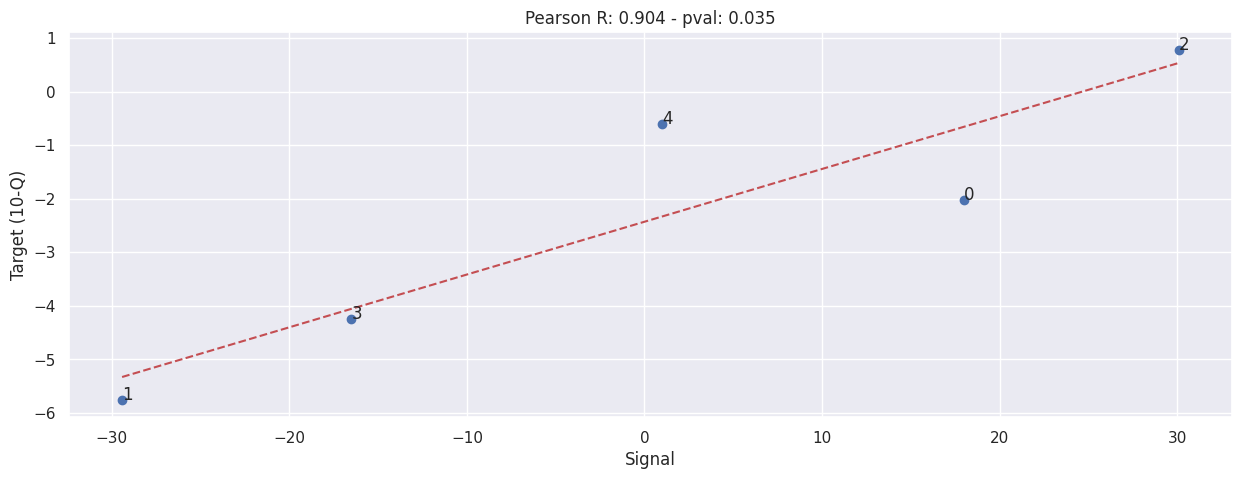
Values taken from trading statements directly, Waitrose only report results twice-a-year, one for H1 and another for the full year.
Also note that Waitrose does NOT split store sales into categories, all store sales are lumped into one, including the Little Waitrose in an urban envrionment and large standalone Waitrose stores.
Read 10Q#
df_waitrose_10q = read_10q('./data/waitrose-trading-statements.csv')
creating start dates from weeks
modifing net sales values by modifier
display_shrinked_dataframe(df_waitrose_10q)
| comp_end_date | base_end_date | comp_start_date | base_start_date | comp_weeks | base_weeks | comp_net_sales | base_net_sales | comp_modifier | base_modifier | |
|---|---|---|---|---|---|---|---|---|---|---|
| 0 | 2022-07-30 | 2021-07-31 | 2022-01-29 | 2021-01-30 | 26 | 26 | 3046.400000 | 3109.440000 | 0.850000 | 0.820000 |
| 1 | 2021-07-31 | 2020-07-25 | 2021-01-30 | 2020-01-25 | 26 | 26 | 3109.440000 | 3299.230000 | 0.820000 | 0.890000 |
| 2 | 2020-07-25 | 2019-07-27 | 2020-01-25 | 2019-01-26 | 26 | 26 | 3299.230000 | 3273.700000 | 0.890000 | 0.950000 |
| 3 | 2022-01-29 | 2021-01-30 | 2021-01-30 | 2020-01-25 | 52 | 53 | 6254.880000 | 6531.700000 | 0.830000 | 0.860000 |
| 4 | 2021-01-30 | 2020-01-25 | 2020-01-25 | 2019-01-26 | 53 | 52 | 6531.700000 | 6571.150000 | 0.860000 | 0.950000 |
Sum our signal#
extract_siganl_sum(df_waitrose_10q, brand="waitrose")
extract_signals_and_targets(df_waitrose_10q, "waitrose")
evaluate(SIGNALS['waitrose'], TARGETS['waitrose'])
Sainsbury’s#
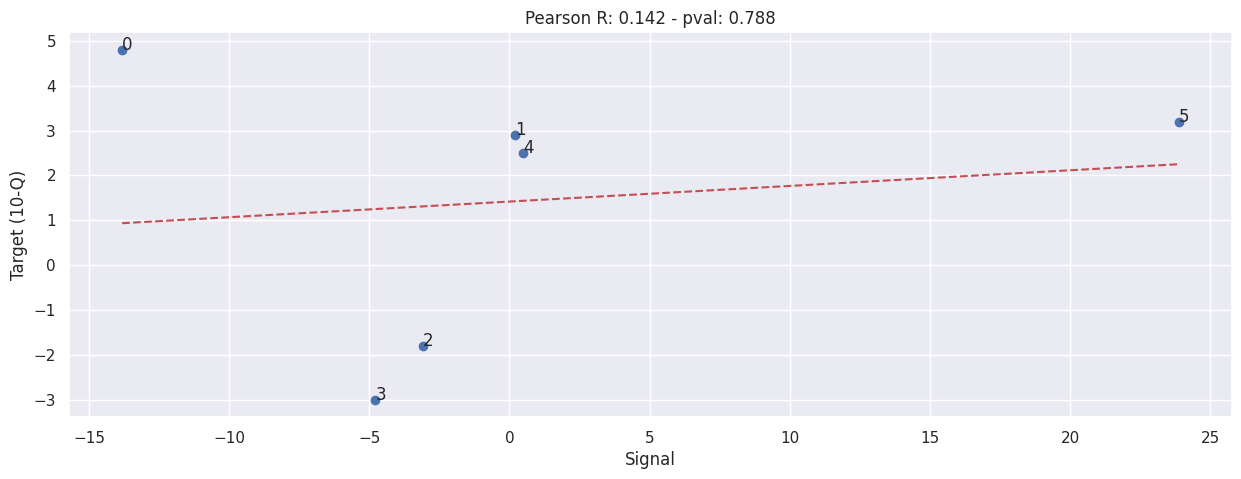
Sainsbury’s 10Q is a bit weird for a few reasons:-
They use a rather irregular reporting cycle, they release result for the past 16, 28, 15, 52 weeks at different times;
They don’t report in store sales numbers directly, they release the like-for-like percentage changes instead;
They don’t release in large store sales result in every report, only 28 weeks and 52 weeks report contains such result; (These are the values we will use, as this closer align to our signal)
Read 10Q#
df_sainsburys_10q = read_10q("./data/sainsburys-supermarket-trading-statements.csv")
creating start dates from weeks
display_shrinked_dataframe(df_sainsburys_10q)
| comp_end_date | base_end_date | comp_start_date | base_start_date | comp_weeks | base_weeks | net_sales_pct_change | |
|---|---|---|---|---|---|---|---|
| 0 | 2023-03-04 | 2022-03-05 | 2022-03-05 | 2021-03-06 | 52 | 52 | 4.800000 |
| 1 | 2022-09-17 | 2021-09-18 | 2022-03-05 | 2021-03-06 | 28 | 28 | 2.900000 |
| 2 | 2022-03-05 | 2021-03-06 | 2021-03-06 | 2020-03-07 | 52 | 52 | -1.800000 |
| 3 | 2021-09-18 | 2020-09-19 | 2021-03-06 | 2020-03-07 | 28 | 28 | -3.000000 |
| 4 | 2021-03-06 | 2020-03-07 | 2020-03-07 | 2019-03-09 | 52 | 52 | 2.500000 |
| 5 | 2020-09-19 | 2019-09-21 | 2020-03-07 | 2019-03-09 | 28 | 28 | 3.200000 |
Sum our signal#
extract_siganl_sum(df_sainsburys_10q, brand="sainsburys")
extract_signals_and_targets(df_sainsburys_10q, "sainsburys")
evaluate(SIGNALS['sainsburys'], TARGETS['sainsburys'])
Tesco#
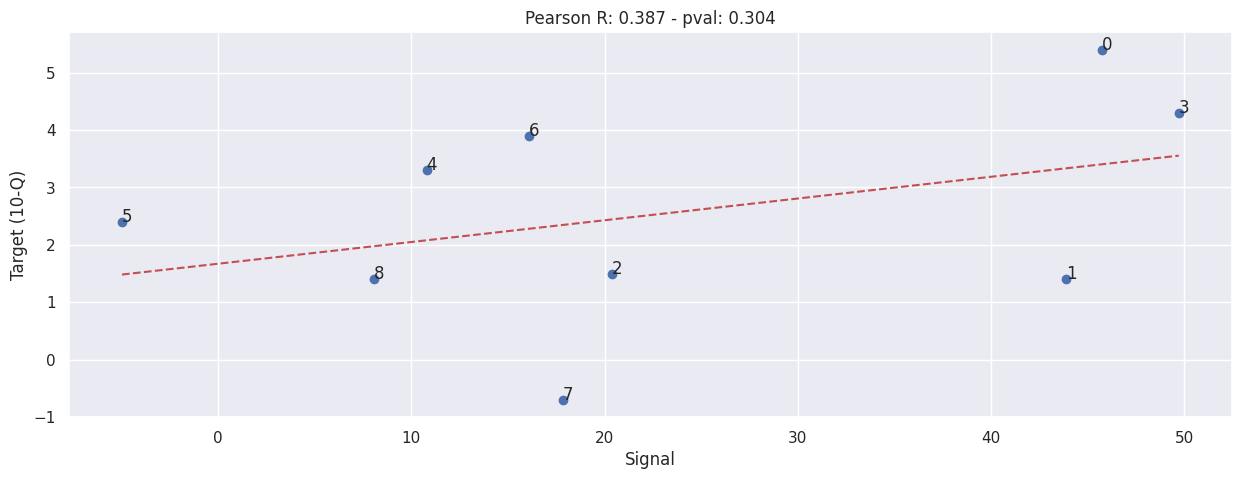
Tesco’s 10Q is a bit weird for a few reasons (similar to Sainsbury’s):-
They use a rather irregular reporting cycle, they release result for the past 16, 28, 15, 52 weeks at different times;
They don’t report in store sales numbers directly, they release the like-for-like percentage changes instead;
They don’t release in large store sales result in every report, they report these when they feel like it; (These are the values we will use, as this closer align to our signal)
Read 10Q#
df_tesco_10q = read_10q("./data/tesco-trading-statements.csv")
creating start dates from weeks
display_shrinked_dataframe(df_tesco_10q)
| comp_end_date | base_end_date | comp_start_date | base_start_date | comp_weeks | base_weeks | net_sales_pct_change | |
|---|---|---|---|---|---|---|---|
| 0 | 2020-05-30 | 2019-05-25 | 2020-02-29 | 2019-02-23 | 13 | 13 | 5.400000 |
| 1 | 2020-08-29 | 2019-08-24 | 2020-02-29 | 2019-02-23 | 26 | 26 | 1.400000 |
| 2 | 2021-02-27 | 2020-02-29 | 2020-02-29 | 2019-03-02 | 52 | 52 | 1.500000 |
| 3 | 2021-08-28 | 2019-08-24 | 2021-02-27 | 2019-02-23 | 26 | 26 | 4.300000 |
| 4 | 2022-01-08 | 2020-01-04 | 2021-08-28 | 2019-08-24 | 19 | 19 | 3.300000 |
| 5 | 2022-01-08 | 2021-01-09 | 2021-08-28 | 2020-08-29 | 19 | 19 | 2.400000 |
| 6 | 2022-05-28 | 2020-05-30 | 2022-02-26 | 2020-02-29 | 13 | 13 | 3.900000 |
| 7 | 2022-05-28 | 2021-05-29 | 2022-02-26 | 2021-02-27 | 13 | 13 | -0.700000 |
| 8 | 2022-08-27 | 2021-08-28 | 2022-02-26 | 2021-02-27 | 26 | 26 | 1.400000 |
Sum our signal#
extract_siganl_sum(df_tesco_10q, brand="tesco")
extract_signals_and_targets(df_tesco_10q, "tesco")
evaluate(SIGNALS['tesco'], TARGETS['tesco'])
ASDA#
No available data.
Morrison#
No available in store sales data, there is however sales data, but given how drastic Covid-19 has changed consumer behaviour, there is no point in correlating the series as it’s just increasing noise. (More and more people are shopping online and travelling to the shop less, can’t treat proportion of online shopper as constant anymore)
Combine Sainsbury’s, Waitrose and Tesco#
evaluate(
    pd.concat([value.set_axis(value.index.map(lambda x: f"{key}/{x}")) for key, value in SIGNALS.items()]),
    pd.concat([value.set_axis(value.index.map(lambda x: f"{key}/{x}")) for key, value in TARGETS.items()]),
)